


Networks Qualifying Examination
January 12th, 1999 -- 12-14pm
You have 2 hours to complete this exam. This duration of time is an
indication as to the level of detail your answers should contain. Answers
should be in the form of written essays (i.e., complete and well-formed
sentences and paragraphs). There is a total of 100 points in this exam.
1. A sample of the ARP cache of a machine in the NSMU CS Department is shown below:
Address               HWtype  HWaddress           Flags Mask         Iface
128.123.64.1          ether   00:E0:F7:26:A1:5C   C     *            eth0
128.123.64.2          ether   08:00:20:7A:8C:14   C     *            eth0
128.123.3.4           ether   00:E0:F7:26:A1:5C   C     *            eth0
128.123.64.69         ether   00:A0:C9:32:BE:D4   C     *            eth0
128.123.64.25         ether   08:00:20:1D:7C:DB   C     *            eth0
128.123.64.11         ether   08:00:20:79:39:DD   C     *            eth0
128.123.9.44          ether   00:E0:F7:26:A1:5C   C     *            eth0
128.123.64.77         ether   08:00:20:1D:A9:B1   C     *            eth0
128.123.64.125        ether   08:00:20:1D:A5:55   C     *            eth0
128.123.30.110        ether   00:E0:F7:26:A1:5C   C     *            eth0
A) [10pts] What does the ARP cache represent, and of what use is it?
B) [10pts] Could some of these computers be separated by bridges (or
switches)? If so, why, and why do the bridges/switches not have entries in
the ARP cache?
c) [10pts] Could some of these computers be separated by routers? If so,
how, and why would they need an ARP cache entry? If there are any such
hosts in the above example, write down which ones they are.
2) [10pts] Every Ethernet interface has an assigned, immutable, and
unique address. Many other data-link protocols are similar in this
regard. Why then do we need network layer addresses, such as IP addresses?
3) [20pts] The original IP network address assignment scheme was based on
three classes of permanent addresses: classes A, B and C, with 1, 2, and
3 bytes of network address, respectively (allowing for some constant bits).
Discuss why these classes were specified and used, what benefit they served,
what current problems they are causing, and techniques and approaches are
being used to overcome these problems.
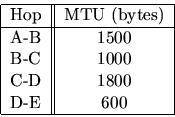
4) [20pts] In connection-less internetworking, such as the IP-based
Internet, every ``hop'' that a packet takes is some data-link connection
between two machines (either routers or hosts). Each of these connections
will have a specific data-link protocol, and they might all be different.
Because of this, each hop will have some Maximum Transmission Unit, which
is the largest data payload that can be atomically transmitted across
that hop. Explain how IP handles sending data across hops with different
MTU's. Furthermore, consider the following example, and explain how IP
will deliver 5Kbytes of data from host A to host E, along all of the
listed hops.
5) [20pts] The Ethernet data-link protocol assumes a shared bus transmission
medium, and detects collisions between multiple senders. Upon detecting a
collision, a ``binary exponential backoff'' method is used to recover from
the collision. Briefly describe what this recovery strategy does, and then
calculate the initial waiting period that would give 90
two iterations of the method, for a 10Mbps Ethernet sending 1.5Kbit frames
(including data and header), with only two stations colliding at any
given time. Assume a worst-case propagation delay for this scenario.