Analysis of Algorithms Qualifying Examination
January 12th, 1999 -- 9-11am
Notes: 1) This is a closed-book test. 2) Please keep your answers brief and to the point. When you are asked to design algorithms, do not write programs. Developing all the algorithmic ideas needed and describing them is enough to fetch full points. Do not go to the extent of declaring variables and arrays and writing programs.
 .
Given the pre-order and
post-order traversals of the binary tree, your task is to compute
the tree itself.
.
Given the pre-order and
post-order traversals of the binary tree, your task is to compute
the tree itself.
 and the post-order traversal
is
and the post-order traversal
is
 .
Construct
the corresponding binary tree.
.
Construct
the corresponding binary tree.
 time.
time.
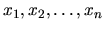 .
For a pair of
numbers xi and xj, the distance between them is given by
dij=|xi-xj|. For the given n numbers, there are
.
For a pair of
numbers xi and xj, the distance between them is given by
dij=|xi-xj|. For the given n numbers, there are
 such distances. Give an algorithm that computes
the smallest n distances in
time.
such distances. Give an algorithm that computes
the smallest n distances in
time.
 ,
is there a subset S of
,
is there a subset S of
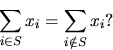
 such that