


Computational Linguistics Qualifying Examination
August 23rd, 1999 -- 1-3pm
Part 1, Grammars (60%)
Write a grammar that accepts the sentences in list A and rejects the sentences in list B.
List A                                 List B

Joe is reading the book.           *Joe has reading the book.

Joe had won a letter.              *Joe had win.

Joe has to win.                    *Joe winning.

Joe will have the letter.          *Joe will had the letter.

The man could have had the book.   *The man can have having the book.

Joe believes that John has to win. *Joe won that John has to win.
Obviously, your grammar should not target these specific sentences, and should handle auxiliaries and tense/aspect in a general way. However, don't worry about other linguistic features; just make sure your grammar accepts the sentences in List A and does not accept the sentences in List B.
The grammar formalism is up to you.
For partial credit, include some documentation. In particular, give a
list of the aspects of English your grammar takes care of. Then,
briefly document your rules, referring to this list.
Part 2, Evaluation of NLP Systems
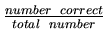 )
on the task of
assigning a word sense to every word (token) that appears in a
corpus.
)
on the task of
assigning a word sense to every word (token) that appears in a
corpus.
Assume that the system was tested on unseen test data, and measured against a gold-standard set of manual annotations. Assume that the agreement among the human annotators is good, the researchers are honest, and the system does not contain bugs.
Shall we conclude that word-sense disambiguation is effectively solved? To answer this, write a critique of the evaluation.